

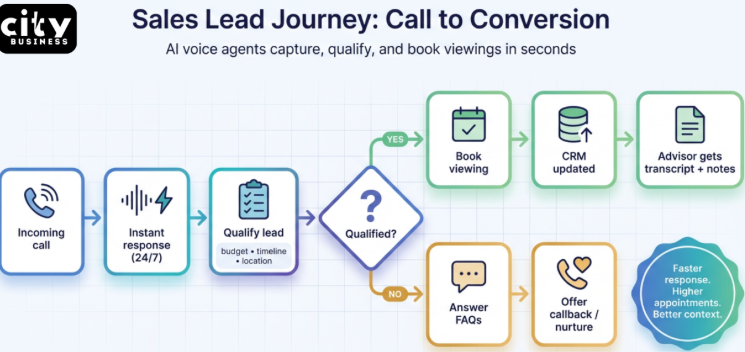
The housebuilding and real estate development sector faces a major challenge: absorbing demand consistently, predictably, and at scale. AI voice agents in real estate are emerging as a structural solution, helping developers manage inquiries, improve customer experience, and convert leads more efficiently.
Although sales surges, aftercare backlogs, and site-level coordination issues often appear overwhelming, they rarely result from a lack of interest or effort. Instead, they reflect communication systems that haven’t kept pace with how people now engage.
AI voice agents have emerged not as an experimental technology but as a structural solution to this mismatch. Their adoption is accelerating because they address operational needs directly. Below are five reasons why they are transforming real estate operations and why ignoring them is a strategic risk.
1. Demand Peaks Outside Normal Operating Hours
The Problem:
In residential development, inquiries spike during launch weekends, campaign-driven bursts, evenings, and weekends. A single launch can generate the equivalent of a full week’s call volume in just 24–48 hours.
The Operational Gap:
Staffing models still rely on traditional business hours. As a result, developers often miss calls, delay follow-ups, and abandon inquiries when interest is highest.
Why It Matters:
Speed is critical in property sales. Prospects who receive contact within minutes convert far more often than those contacted hours later. Consequently, every delay reduces momentum and increases funnel leakage.
How AI Voice Agents Help:
The AI agent actively handles demand volatility. Consequently, it answers every call instantly, regardless of time or volume. Moreover, the system scales automatically, without proportional increases in headcount, ensuring that demand spikes are managed by design, not as emergencies.
2. Missed and Abandoned Calls Directly Impact Revenue
The Problem:
During peak periods, even well-staffed teams experience missed calls, voicemail reroutes, or delayed email follow-ups.
The Cost:
Buyers rarely wait. When one developer fails to respond, another often captures the lead. Therefore, missed calls translate directly into lost revenue.
The Hidden Effect:
Abandoned calls also create internal inefficiencies: follow-up lists grow, advisors chase cold leads, and CRM data becomes incomplete.
AI Solution:
AI voice agents ensure zero unanswered calls. They qualify inquiries, capture structured data, and move interactions to a clear next step. As a result, they protect revenue that would otherwise be lost silently.
3. Consistency of Information Matters as Much as Availability
The Problem:
During high-demand periods, advisors sometimes provide slightly different answers. Consequently, customers receive mixed messages about availability, timelines, or processes.
Why Inconsistency is Costly:
Inconsistent information forces customers to call back for clarification. Advisors must correct statements, and aftercare tickets bounce between teams. Over time, trust erodes, and operational inefficiency grows.
Modern Expectation:
Customers now expect the same accurate information across all channels and times. Therefore, consistency is no longer optional.
AI Solution:
AI voice agents deliver accurate, governed responses every time. Furthermore, they reduce operational noise and stabilize the customer experience, ensuring consistency without additional staff effort.
4. Conversations Must End in Actions, Not Promises
The Problem:
Many calls conclude with vague statements like “someone will get back to you.” These handoffs create delays and increase the risk of customer drop-off.
Why This is Inefficient:
Every extra step increases handling time and the chance of failure. In aftercare, poorly structured calls lead to incomplete tickets; in sales, unclear next steps reduce conversions.
Operational Requirement:
Conversations should end with a completed action, such as booking an appointment, raising a ticket, sending instructions, or confirming a delivery slot.
AI Solution:
Integrated with CRM, ticketing, and scheduling systems, AI voice agents execute actions during the call itself. As a result, progress happens immediately, data remains accurate, and follow-up loops shrink.
5. ROI is Faster and More Predictable Than Expected
Common Misperception:
Organizations often treat AI deployments as long-term bets with uncertain payback.
What the Data Shows:
When focused on high-volume, repeatable interactions, AI voice agents typically reach ROI within 3–9 months. Gains come from faster lead response, higher appointment rates, reduced handling time, and fewer missed calls.
Why ROI Compounds:
As transcript data accumulates, organizations refine intents, improve content, and expand coverage. Performance improves through smarter system design, not additional staffing.
Strategic Implication:
AI voice agents quickly move from cost mitigation to competitive advantage, particularly when treated as a continuously managed capability rather than a one-off tool.
Closing Perspective
AI voice agents do not replace human expertise. Instead, they protect it, handling repetitive, volatile, and scalable tasks so humans can focus on judgment, relationship-building, and complex problem-solving.
For housebuilders and developers, the question is no longer whether AI voice agents belong in the operating model. The real question is whether existing communication systems are fit for the realities of modern demand.


