

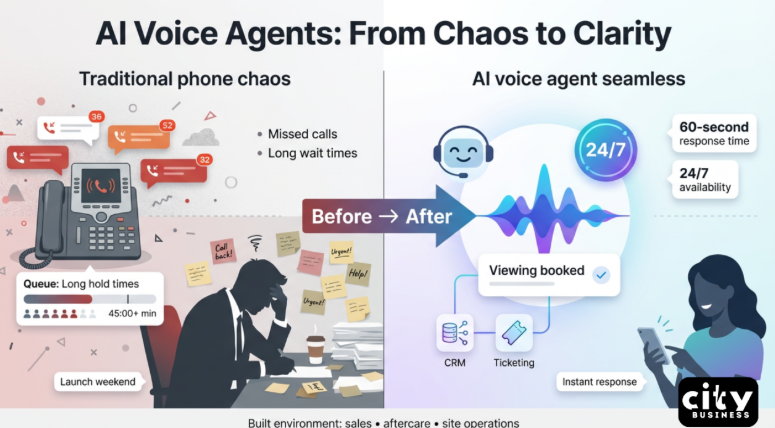
As AI voice agents gain visibility across real estate and housebuilding, the gap between successful deployments and expensive disappointments is widening.
The difference rarely lies in the underlying technology. Instead, it stems from the absence of clear design principles. Organisations that treat AI voice agents as tactical add-ons usually struggle. Conversely, those who design them as part of their operating model see durable results.
Three core principles consistently separate the two.
1. Prioritise Always-On Availability as a Structural Requirement
Customer demand does not conform to traditional office hours. Sales inquiries, defect reports, and site coordination calls peak during evenings, weekends, and launch periods.
Relying on extended shifts, call forwarding, or overflow voicemail introduces fragility. These coverage gaps reappear as soon as demand spikes beyond forecasts. Therefore, availability is no longer a staffing question; it is a design question. If you fail to answer calls instantly, you lose opportunity and trust before a conversation even begins. Consequently, availability is now a core part of your digital operational infrastructure.”
What effective AI voice agents do differently: They provide a guaranteed 24/7 response as a baseline condition. These agents eliminate queue management and call deflection because they do not degrade under load. Consequently, availability becomes predictable and non-negotiable.
2. Design Conversations to Drive Completed Actions
Many current AI deployments focus solely on conversational quality. While these calls sound natural, the outcomes often remain manual. When a conversation ends without a concrete action, it simply defers work to a human. This approach preserves bottlenecks instead of removing them.
Operational excellence requires more. Every interaction must conclude with a tangible outcome: an appointment booked, a ticket logged, a delivery confirmed, or information sent.
How effective agents deliver this: Effective agents integrate directly into CRM, scheduling, and service platforms. They execute actions during the call rather than promising them for later. In short, the conversation does the work.
3. Ensure Human Escalation is Immediate and Informed
Many managers treat escalation as a failure. In reality, escalation is inevitable, but poorly designed handovers destroy customer confidence. Usually, escalation fails because callers move to a human without any context. They must repeat information, which causes frustration to escalate alongside the complexity of the issue.
What effective escalation looks like: AI agents must recognise sensitivity, complexity, or risk immediately. They should escalate the call instantly while providing a summary, transcript, and intent. As a result, human agents step in where the situation requires judgment, not where information gathering failed. This protects both trust and efficiency simultaneously.
Closing Perspective
AI voice agents succeed when you treat them as operational infrastructure rather than novelty interfaces. Availability, action orientation, and intelligent escalation provide the foundations for scale. By following these principles, you can grow your operations without creating chaos.
To learn how to implement these strategies effectively, you can download our AI Voice Agents Strategic Handbook for real estate developers.
